Design for Elders: Why Accessibility Is Not a Feature, but a Responsibility
By Prutana Gali · Published
We are quick to blame older adults for struggling with technology. But these are failures of design, not people, and building clear, accessible interfaces is a responsibility, not an optional feature.
Many of us recognize a quiet moment when a parent hesitates before tapping a button. A grandparent squints at a screen held at arm's length. A familiar request arises: "Can you do this for me?"
It is easy to dismiss these instances as a lack of tech skills. However, as a design student and a member of a rapidly aging society, I have come to see these moments not as failures of individuals, but as failures of design.
Nothing we create is neutral, because every choice centres certain people while pushing others to the margins. What feels intuitive or effortless to one group can become confusing, inaccessible, or discouraging to another. Inclusion and exclusion are not accidents; they are the direct result of whose needs are considered from the start.
Why Design for Elders Matters More Than We Admit
When an interface is cluttered, low in contrast, or too complicated, it quietly puts up barriers. These barriers do not come with warning signs, yet they still deny access. For older adults, this often leads to dependence on children, caregivers, or unwilling intermediaries.
On the other hand, thoughtful design does something remarkable in its simplicity. It lets our parents order medications without help. It allows our grandparents to video call without fear of making mistakes. It restores independence in places where dignity can be compromised by complexity.
What we build determines whether ageing feels like a gradual adjustment or a constant struggle against systems not meant for them. Thoughtful interfaces can soften that transition instead of making it harsher.
Dispelling the Myth: "Elders Aren't Techy"
One persistent myth in conversations about technology is that elders are resistant to digital tools. Yet data from the Pew Research Center shows that a large proportion of adults over 65 actively use smartphones and the internet for communication, banking, and healthcare-related tasks (Pew Research Center, 2021) in the US. This number is also increasing in other countries. The issue is not adoption; it is design that prioritises speed and novelty over clarity and reassurance.
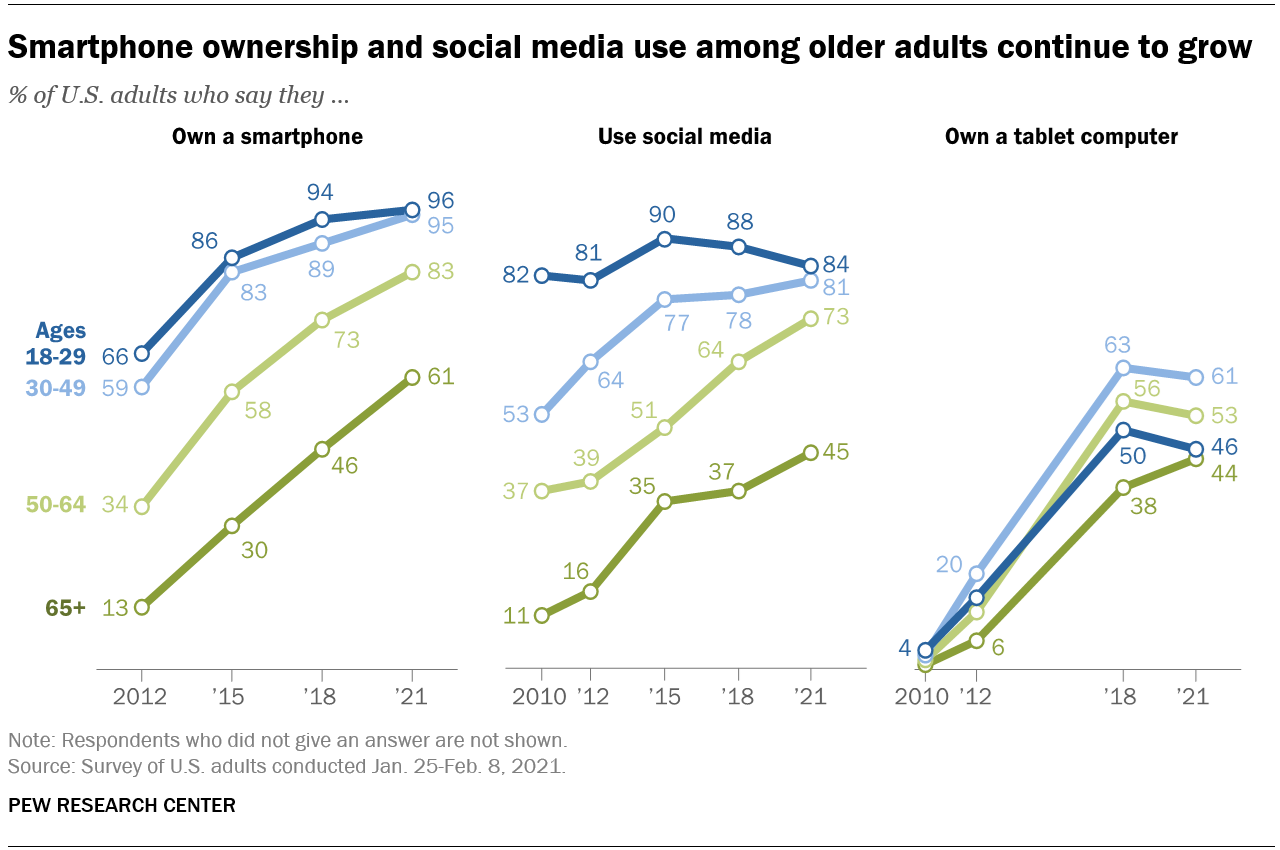
When products are built around rapid interactions, hidden gestures, and constantly changing patterns, they naturally favour users who grew up alongside digital systems. Elders, who often approach technology more carefully, then appear "slow" or "confused," when in reality the system has simply not met them halfway. Framing elders as the problem allows designers to avoid asking harder questions about responsibility and care.
Accessibility by Default, Not by Exception
Too often, accessibility enters the process at the very end, when most design choices are already fixed. Bringing it in early changes how layouts, interactions, and language are imagined in the first place.
Larger text sizes are not just nice to have; they are essential for aging eyes. High-contrast color schemes are not aesthetic choices; they improve clarity. Adjustable font sizes, spacing, and brightness recognize a basic truth: no two eyes see a screen the same way.
If a user cannot clearly see an interface, they cannot use it effectively. When this reality is ignored, what looks clean or minimal often becomes inaccessible.
As a novice UI/UX designer, I'm learning that restraint in design isn't about doing less. It's about focusing on what's essential and executing it well.
Technology That Adapts to the User
Good design should not demand precision from those with limited dexterity.
Small touch targets, complex gestures, and hidden interactions may please younger users, but they often frustrate older adults. Larger buttons ease the worry of tapping the wrong one. Simple, clearly labeled actions work better than complex gestures. Thoughtfully designed voice commands can completely remove reliance on fine motor skills.
These design decisions do not lessen sophistication; they redefine it.
When designing for older adults, technology must adjust to human limitations. This adaptability also helps users with motor challenges, temporary injuries, or situational issues. Inclusivity scales beautifully.
The Quiet Power of Clarity
Cognitive overload can quietly undermine the experience of users, especially those who are not familiar with digital norms, because interfaces that present too many options at once tend to confuse rather than empower.
Over the years, I have learned that clarity in language and familiarity in layouts are essential, as predictability, though it may seem unremarkable, provides a quiet reassurance that builds trust.
When users know what to expect, their confidence grows, and with confidence comes the ability to interact independently and comfortably. It is both humbling and enlightening to realize that the most successful design is often invisible; it does not call attention to itself but instead works seamlessly, allowing the experience to feel effortless and natural.
Designing with Empathy
UI/UX design constantly challenges us to examine our assumptions. Who exactly counts as the "average user," and who is left behind when speed is valued over clarity? How do we define efficiency when it must be balanced against human dignity?
Working on designs for elders has shown me that usability extends beyond metrics and heuristics. It requires transforming empathy into structure and translating care into every pixel, margin, and line of text.
In theory, design education teaches us to focus on users. In practice, it reminds us that these users are our parents, our grandparents, and ultimately, one day, ourselves.
A Responsibility, Not a Niche
Elder-friendly design should not be limited to special products or senior-focused platforms. It should be part of mainstream digital ecosystems.
When accessibility becomes the norm, everyone benefits. Parents can stay independent longer. Caregivers face less strain. Designers create work that lasts beyond trends.
Most importantly, technology can fulfill its original promise: to make life easier.
As we move toward more complex digital futures, the question is not whether elders can keep up. It is whether we, as designers, are willing to slow down and design with care.